

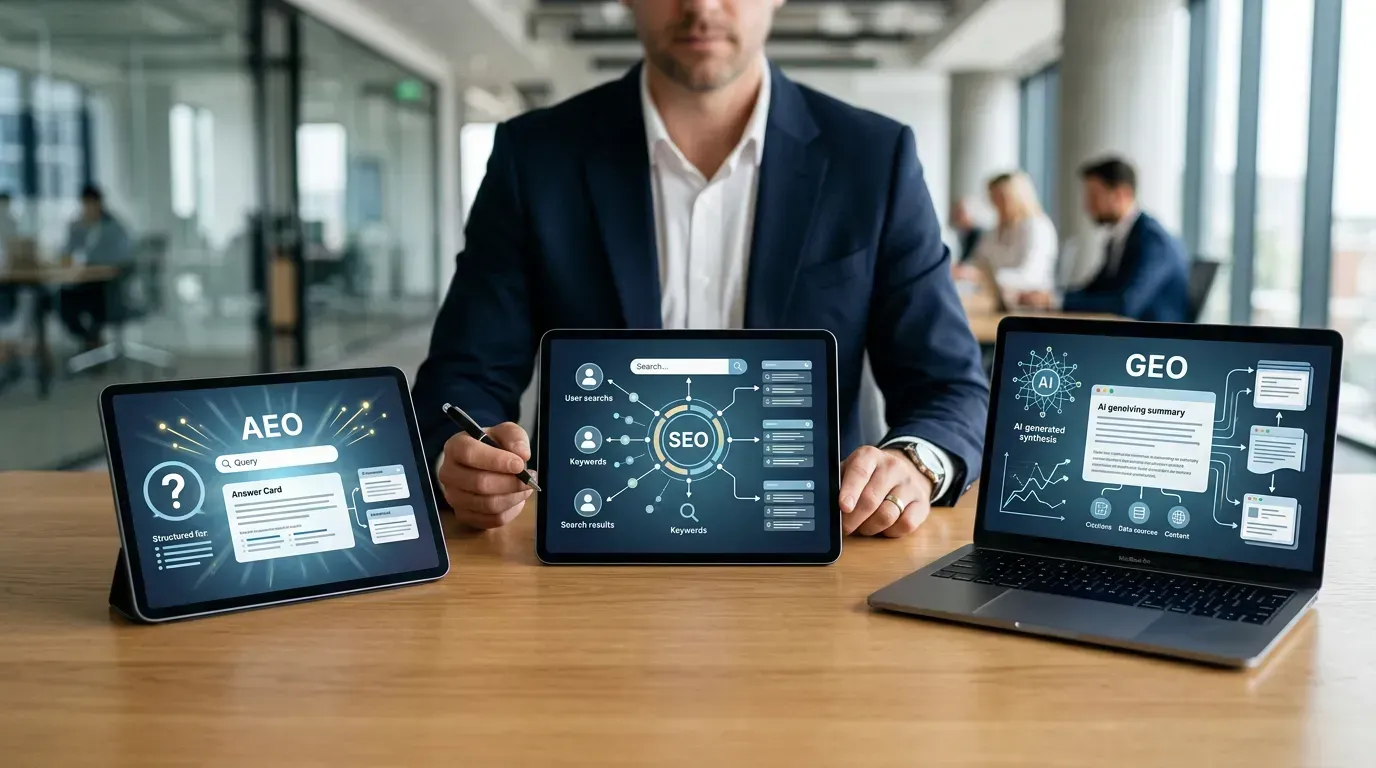

Search isn’t happening in one place anymore. People still use Google, but they’re also getting direct answers from AI-powered search experiences, assistants, and generative tools. That shift has introduced a fresh wave of marketing terms, including AEO and GEO. Add traditional SEO to the mix, and it’s easy to wonder whether businesses suddenly need three completely separate strategies.
The reality is more connected. AEO vs SEO isn’t simply old marketing versus new marketing, and GEO doesn’t mean everything you’ve done for search should be thrown away. These approaches have different goals, but they share many fundamentals. Let’s break down SEO, AEO, and GEO, where they overlap, and what businesses can focus on without getting buried under another pile of acronyms.
Start With SEO: The Foundation Isn’t Going Away
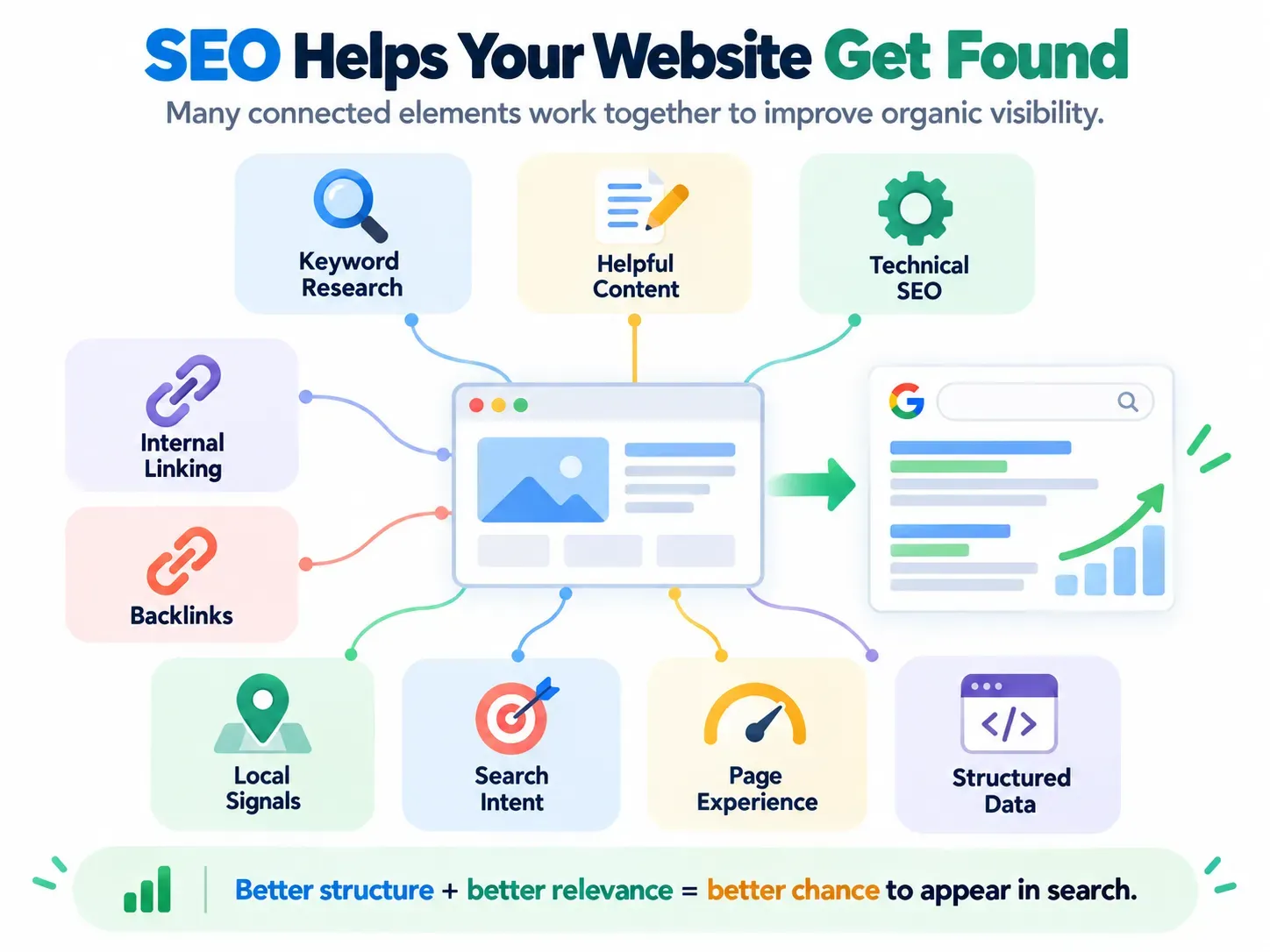
SEO, or search engine optimization, focuses on improving a website’s ability to appear in organic search results. Traditional SEO can involve several areas, including:
-
Keyword and topic research
-
Helpful website content
-
Technical website improvements
-
Internal linking
-
Backlinks and authority
-
Local search signals
-
Search intent
-
Page experience
-
Structured data
The goal is to make your website understandable, accessible, relevant, and useful enough to gain visibility when people search for information about your business. Search results have changed considerably over the years, but that basic objective still matters.
SEO is bigger than rankings
Rankings matter, but they’re only one piece. A strong SEO program should also attract relevant visitors and connect those visitors with information that helps them move forward. A page ranking first for an unrelated query isn’t particularly useful. A page ranking for a high-intent service search that generates qualified inquiries can have much greater business value.
That’s why search intent has become such an important part of content strategy. If someone searches “how often should a roof be replaced,” they probably need educational information. Someone searching “roof replacement company in Dallas” is much closer to choosing a provider. SEO content should recognize those differences.
Strong SEO creates useful source material
This becomes especially important once AEO and GEO enter the conversation. AI systems and answer-based search experiences need information to work with. Clear explanations, strong topical coverage, credible information, and well-organized pages give machines and humans more context. That means many practices businesses already use for SEO can also support visibility across newer search experiences.
AEO Focuses on Becoming the Answer
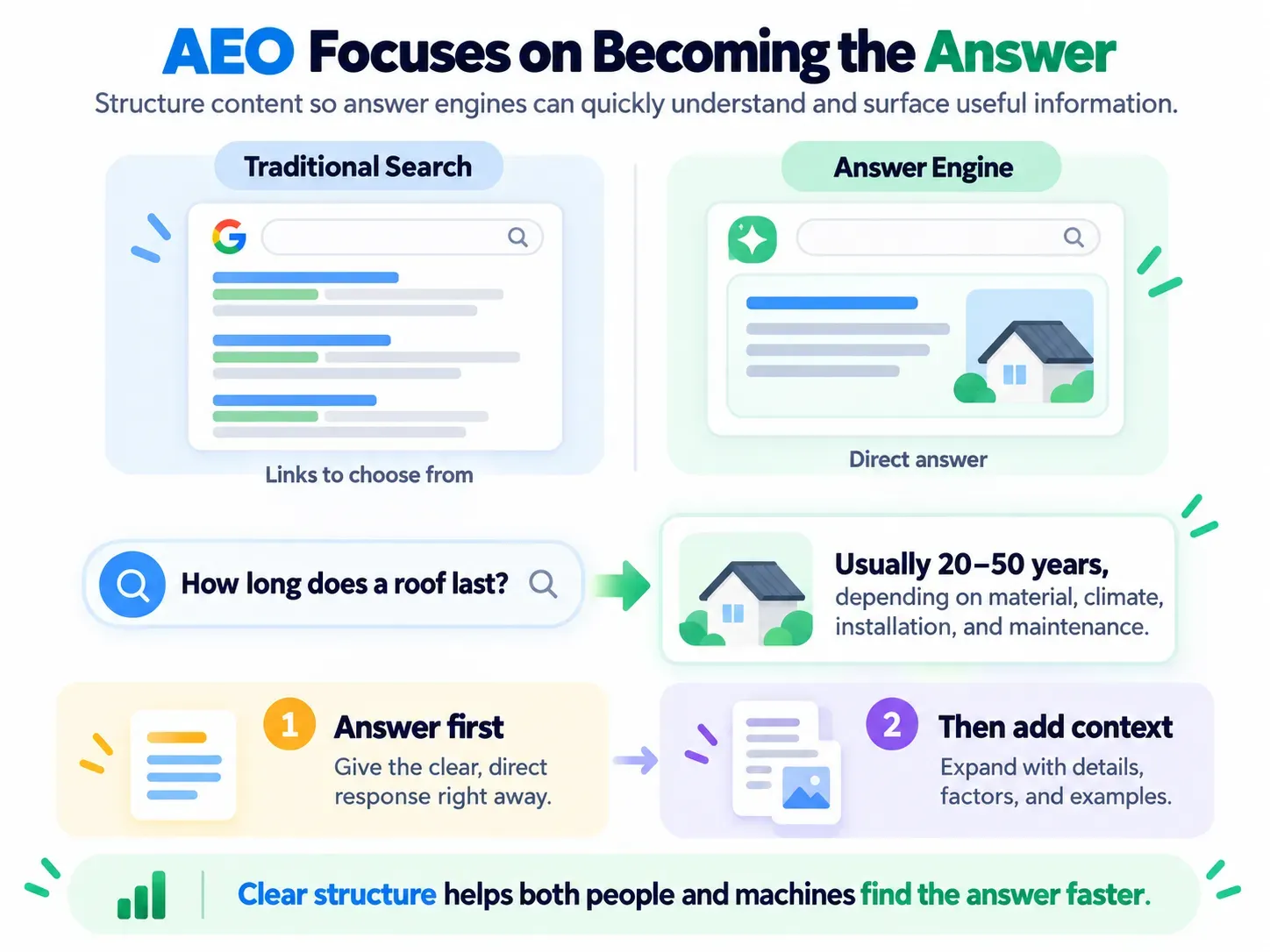
AEO stands for answer engine optimization. The idea is straightforward: structure and improve content so systems that provide direct answers can easily understand and surface useful information. Traditional search often encourages someone to choose from a list of links. Answer engines can shorten that process by presenting information directly. That changes how marketers need to think about content.
Answer the question clearly
Long content can be valuable, but readers shouldn’t have to wade through 700 words to find a basic answer.
Suppose you’re creating content around the question:
“How long does a roof last?”
A weak page might spend several paragraphs discussing the importance of roofing before providing a useful answer. A stronger approach gives the reader a concise answer first and then expands on the factors that affect roof lifespan. This structure works well because both people and machines can quickly identify the relevant information.
Build content around real questions
Questions are particularly useful for AEO because they reflect how people naturally search and interact with AI tools. Your content can address questions such as:
-
What does this service cost?
-
How does the process work?
-
How long does it take?
-
What causes this problem?
-
When should I call a professional?
-
What’s the difference between the two services?
-
Which option works for a particular need?
Questions can guide headings, paragraphs, service pages, blogs, and supporting content.
Structure matters
Good answer engine optimization also benefits from clear organization.
Descriptive headings tell readers what each section covers. Short paragraphs make information easier to process. Lists can organize steps or comparisons. Tables can help explain structured information when they’re genuinely useful.
The goal isn’t to write for robots. It’s to remove unnecessary friction from the information. That’s where the AEO vs SEO discussion becomes less dramatic. AEO adds emphasis on direct answers and machine-readable clarity, but many of those practices already support strong SEO and a better user experience.
GEO Brings Generative AI Into the Search Conversation
GEO generally stands for generative engine optimization. It focuses on improving how a brand, website, or information source is understood and represented in AI-generated answers and generative search experiences.
Instead of focusing only on whether your page appears in a traditional list of search results, GEO raises another question:
Can generative systems confidently understand and reference information connected to your company and expertise?
That’s where generative engine optimization starts overlapping heavily with broader search strategy.
AI visibility isn’t just another blue link
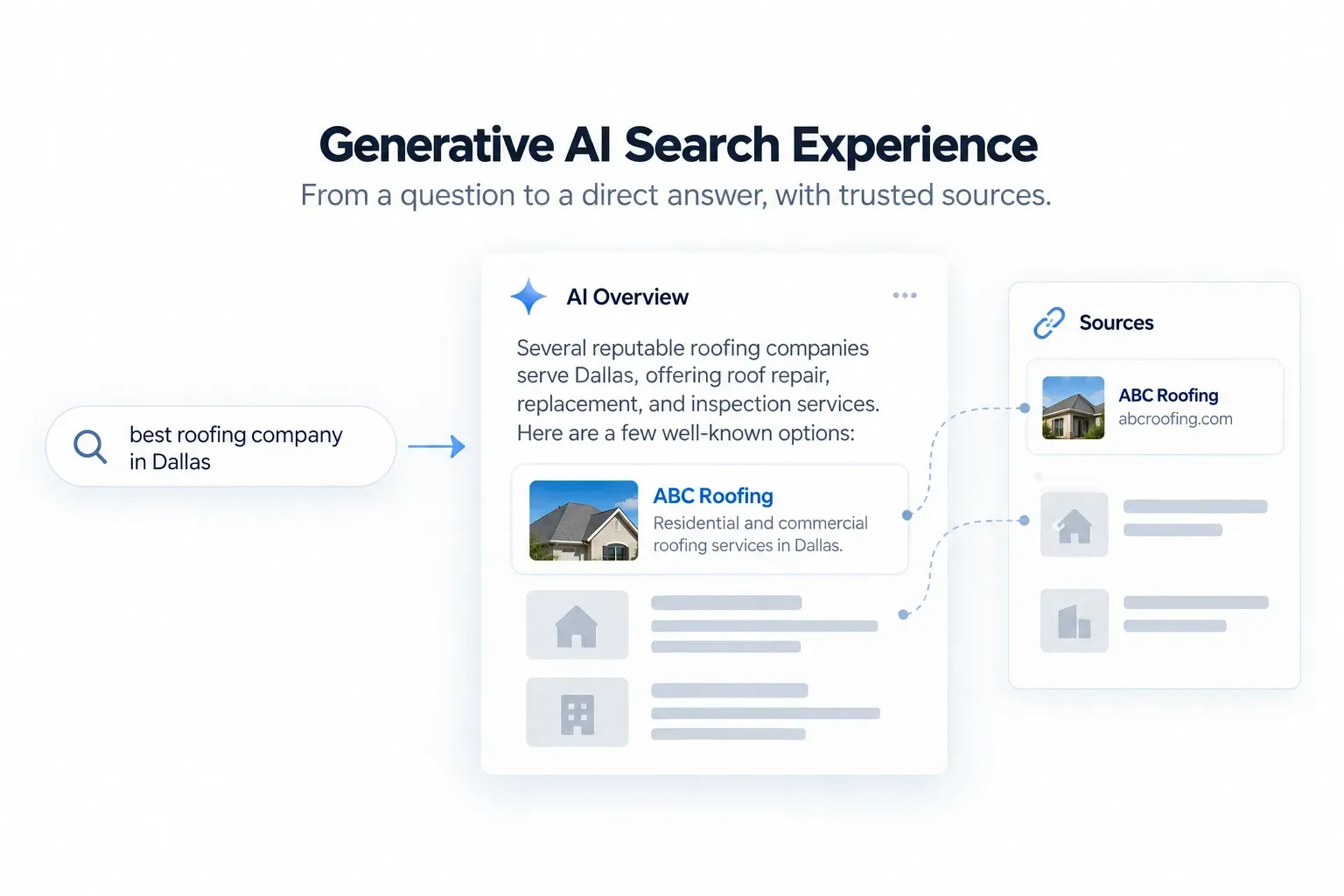
Generative search experiences can synthesize information rather than simply displaying a page title and link. That creates a different type of visibility. Your company might be referenced in an answer. Information from your website may be used to generate a response. Your brand could also appear alongside other sources when someone researches a topic. This makes clarity and credibility increasingly important.
Make your expertise easy to understand
Generic content doesn’t give search systems much reason to associate a company with a specific topic. Businesses can strengthen their online information by publishing content that reflects genuine experience and knowledge. That could include:
-
Detailed service information
-
Original examples
-
Case studies
-
Firsthand insights
-
Clear company information
-
Expert explanations
-
Useful statistics backed by reliable sources
-
Specific answers to customer questions
Specificity gives content substance. Saying “SEO is important for businesses” doesn’t contribute much. Explaining why a local service page isn’t generating leads, which elements to review, and how those elements affect conversions provides far more useful information.
Consistency helps build context
Your website isn’t the only place where information about your company exists. Business profiles, directories, social accounts, reviews, industry websites, press coverage, and other online mentions can all contribute to the broader information surrounding a brand. That makes consistency valuable.
Your services, expertise, business details, and positioning shouldn’t tell completely different stories depending on where someone finds you. Strong GEO marketing is partly about building a clear digital footprint that makes it easier to understand who you are, what you do, and which topics you’re connected to.
SEO, AEO, and GEO Have More in Common Than You Think
The terminology makes these strategies sound like separate marketing departments. In practice, there’s plenty of overlap:
-
SEO aims to help search engines understand and rank useful information.
-
AEO wants answer-based systems to identify clear responses to questions.
-
GEO wants generative systems to understand, contextualize, and potentially reference useful brand information.
All three benefit from strong content.
The overlap starts with quality
Content written only to hit a keyword count isn’t enough. Useful content should demonstrate that the company understands the topic and the needs behind the search. That means providing clear explanations, relevant examples, logical organization, and information people can actually use.
Authority supports all three
A website doesn’t build authority with a single blog post. Authority develops through a larger body of useful information and credible signals. For a digital marketing company, that might mean covering SEO strategy, paid media, website conversions, analytics, social media, local search, and other connected topics in meaningful depth.
Internal links can help connect those topics across the website. External recognition can add another layer of credibility. The stronger the overall digital presence becomes, the easier it is for search systems and potential customers to understand what the business knows.
Technical health still matters
AI search doesn’t make technical SEO irrelevant. Search systems still need to access and understand website content. That means businesses should continue paying attention to areas such as:
-
Crawlability
-
Indexation
-
Site structure
-
Internal linking
-
Mobile usability
-
Page performance
-
Structured data where appropriate
A fantastic article can’t contribute much to organic visibility if search engines can’t access it properly.
User intent connects everything
SEO, AEO, and GEO ultimately revolve around people looking for information. The formats may change, but the need remains: Someone has a question. Your company has information that can help answer it. The job of modern search marketing is to make that connection easier across different search experiences.
(Designer suggestion: Use a Venn diagram with SEO, AEO, and GEO. Place Helpful Content, Authority, Clear Structure, Search Intent, Technical Health, and Credibility in the overlapping center.)
Build One Search Strategy That Can Work Across Multiple Experiences
Businesses don’t necessarily need three isolated strategies and three separate content calendars. A more practical approach is to build a strong search foundation and adapt it for the ways people now find information.
Step 1: Strengthen your core SEO
Start with the basics. Make sure your website clearly explains your services. Create pages around relevant search intent. Address technical issues. Improve internal linking. Strengthen local signals when location matters. Without that foundation, adding another acronym won’t solve much.
Step 2: Make important answers easy to find
Review your existing content:
-
Are straightforward questions buried under long introductions?
-
Are important explanations vague?
-
Could headings describe sections more clearly?
Give readers useful answers without making them hunt for them.
Step 3: Add depth competitors can’t easily copy
Generic information is everywhere, so you need to set your business apart:
-
Add experience.
-
Use original examples.
-
Explain your process.
-
Include useful observations from customer interactions.
-
Publish case studies when appropriate.
-
Add proprietary data when you have it.
Your content should show why your company has something meaningful to contribute.
Step 4: Strengthen your wider brand presence
Your website is the center of your digital presence, but it isn’t the whole picture. Keep important company information consistent across relevant channels. Build legitimate industry mentions. Keep business profiles current. Encourage real customer reviews. Publish useful content across platforms where your audience spends time. This can strengthen GEO marketing while also supporting traditional visibility and customer trust.
Step 5: Measure more than rankings
Rankings remain useful, but search behavior is becoming more fragmented. Your measurement strategy should also consider:
-
Organic traffic
-
Qualified leads
-
Conversions
-
Branded searches
-
Referral traffic
-
Search visibility
-
AI-driven referral traffic when identifiable
-
Customer acquisition
Search success should eventually connect with business performance. That’s the metric that puts everything else into perspective.
One Search Strategy, More Places to Be Found
SEO, AEO, and GEO use different labels because search experiences are changing. But treating them like three completely disconnected marketing disciplines can create unnecessary complexity. Strong content, clear answers, credible expertise, technical health, and a consistent online presence can support visibility across all of them.
We know keeping up with search changes can feel like a full-time job when new terminology keeps entering the conversation. At Hite Digital, we bring together SEO, content, web strategy, analytics, and digital marketing expertise to help businesses build visibility into how people actually search. Explore Hite’s digital marketing services or contact our team to build a search strategy ready for what’s next.