



Getting found locally is only the beginning. A person can see your business on Google, visit your website, read your reviews, and still leave without calling or filling out a form. Visibility creates opportunity, but you need a clear path that turns that attention into action. That’s where local lead generation comes into play. Instead of treating SEO, your website, paid ads, reviews, and follow-up like separate activities, a funnel connects them around one goal: bringing the right people closer to becoming customers.
For local businesses, this matters because people rarely make decisions after one interaction. They might find you through Google Maps, visit your website, compare reviews, leave, and return later through another search.
A strong funnel keeps your business visible and helpful throughout that process. In this guide, we’ll explain each stage of the local lead-generation funnel, show where SEO fits, and cover the common gaps that cause potential customers to drop off. Let’s see how you can turn more local searches into real business opportunities.
What Is a Local Lead Generation Funnel?
A lead generation funnel represents the path someone takes from first learning about a business to becoming a lead and, eventually, a customer. For local businesses, that path can include several digital touchpoints.
Someone might:
-
Search for a service on Google.
-
See your Google Business Profile.
-
Read several reviews.
-
Visit a service page.
-
Check your pricing or process.
-
Leave the website.
-
Search for your company again later.
-
Submit a form or call.
That entire journey is part of your lead generation funnel. It usually gets broken into three broad stages: awareness, consideration, and conversion. After conversion, follow-up and retention can continue the relationship.
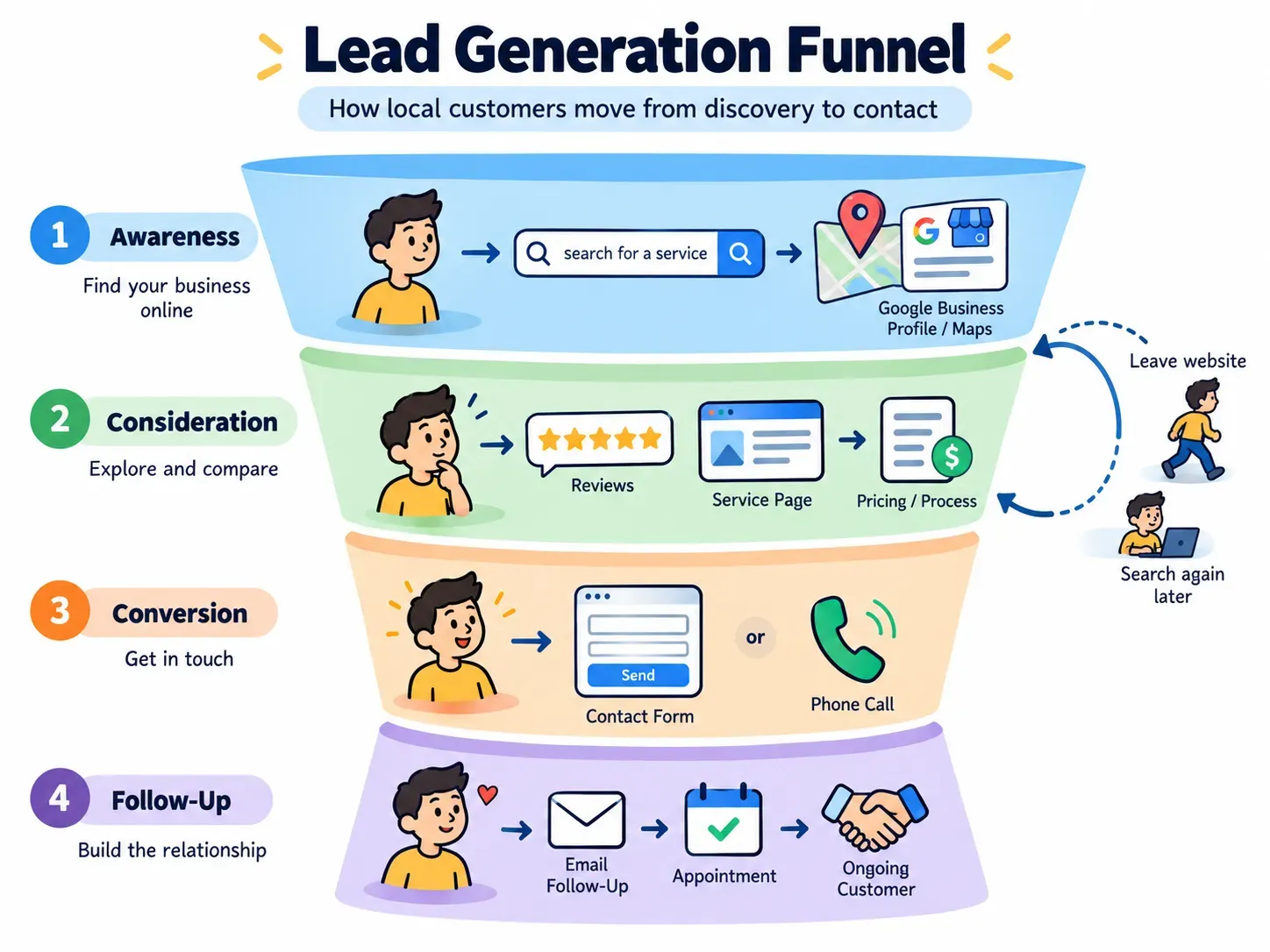
Local funnels can move quickly
Local intent can shorten the buying journey. Someone searching “emergency plumber near me” probably has a very different timeline from someone searching “how often should plumbing pipes be inspected?”
One person needs a provider now. The other may simply be researching. Your funnel needs content for both situations. That’s one reason local lead generation shouldn’t focus only on getting more traffic. It should attract relevant searches and provide people with the information they need, based on how close they are to taking action.
Stage One: Spark Awareness and Get Found Locally
No funnel works without people entering it. The awareness stage is where someone first encounters your company. For a local business, search engines are often a major entry point. This makes your local SEO strategy an important piece of the funnel.
Build visibility around relevant searches.
Think about what people actually type when they need your services. A roofing company could target searches around:
-
Roof repair near me
-
Local roofing company
-
Hail damage repair
-
Emergency roof leak repair
-
Roof replacement in [city]
Those searches reveal different levels of intent, but they all create opportunities for visibility.
Give Your Google Business Profile Some Attention
For local searches, your Google Business Profile can become one of the first things people see. Keep important information accurate and useful, including:
-
Business category
-
Services
-
Hours
-
Contact information
-
Photos
-
Business description
Don’t chase traffic without intent
More website visitors might look impressive in a report. Still, traffic that never has a realistic chance of becoming business doesn’t add much fuel to your growth. A strong local SEO strategy focuses on relevance.
Ten visits from people actively searching for your service in your area can be more valuable than hundreds of visits from people outside your market. The goal isn’t to fill the top of the funnel with everybody. It’s to attract more of the right people.
Stage Two: Turn Attention Into Trust
Someone found you. Now you need to give them a reason to stay. The consideration stage is where potential customers evaluate whether your company can solve their problem. They’re often comparing options, reading reviews, checking websites, and looking for signs that a company understands their needs.
Answer the questions people ask before contacting you
Good service pages shouldn’t read like long advertisements. They should answer useful questions, such as:
-
What does the service include?
-
Who needs it?
-
What problems does it solve?
-
How does the process work?
-
How long can it take?
-
What affects pricing?
-
Why should someone choose your company?
-
What happens after someone contacts you?
When visitors understand what you offer and what happens next, contacting you feels like a smaller step.
Build authority with helpful content
Blog posts, FAQs, guides, videos, case studies, and other educational resources can support people who aren’t ready to contact you yet. A heating and cooling company, for example, could publish articles about:
-
Signs an AC needs repair
-
Repair vs. replacement
-
Reasons energy bills suddenly increase
-
How often is HVAC maintenance needed
Put proof where people need reassurance
Don’t make visitors hunt for reasons to trust you. Use relevant proof throughout your website, such as:
-
Customer reviews
-
Testimonials
-
Project examples
-
Case studies
-
Certifications
-
Years of experience
-
Before-and-after photos
The consideration stage is often where businesses lose momentum. They generate the click but don’t provide enough information or confidence to earn the next action.
Stage Three: Remove Friction and Generate the Lead
Your visitor has found you and likes what they see. Now don’t make the final step harder than it needs to be. The conversion stage of the lead generation funnel is where interest becomes a measurable action. Depending on the business, that might mean:
-
Calling
-
Filling out a contact form
-
Requesting a quote
-
Scheduling an appointment
-
Sending a message
-
Booking a consultation
Make calls to action obvious
People shouldn’t need to search for your contact button. Place calls to action at natural points throughout important pages, especially near sections where you’ve answered a major question or built trust.
Keep the wording clear, too. For example:
“Submit” doesn’t say much.
“Request Your Estimate” tells people exactly what happens next.
Keep forms focused
Long forms can drain momentum. Ask for the information you actually need to start the conversation. You can gather additional details later. For many service businesses, that might include:
-
Name
-
Phone number
-
Email
-
Service needed
-
Short message
Every additional field should have a purpose.
Make mobile conversion easy
Local searches often happen when people are ready to act. Your website needs to support that urgency across mobile devices. Check whether:
-
Phone numbers are easy to tap
-
Buttons are large enough
-
Forms work smoothly
-
Pages load quickly
-
Text is readable
-
Navigation stays simple
A conversion opportunity can disappear fast when someone has to fight with the website.
Stage Four: Track the Funnel From Search to Sale
A digital marketing funnel isn’t very useful if you can’t see where people are dropping out. Tracking helps connect marketing activity with real outcomes. Website traffic is one part of the story. Leads and customers tell you much more.
Measure each stage
At the awareness stage, you might monitor:
-
Search visibility
-
Google Business Profile interactions
-
Organic traffic
-
Paid impressions
-
Website visits
During consideration, useful signals can include:
-
Service page engagement
-
Returning visitors
-
Case study views
-
Review interactions
-
Important CTA clicks
At conversion, focus on:
-
Form submissions
-
Calls
-
Bookings
-
Quote requests
-
Qualified leads
Then connect those leads to sales whenever possible.
Find the leak before adding more traffic
Suppose 2,000 people visit your website every month, but only five contact you. Your first reaction might be to generate another 1,000 visits. But what if the real problem is the website? Maybe the offer is unclear. The service pages might lack proof. The form could be too long. The CTA may be buried. Sending more traffic into a leaky funnel can mean paying to lose more people. Instead, identify the weak stage. A digital marketing funnel gives you a framework for doing that.
Keep the Funnel Moving After Someone Converts
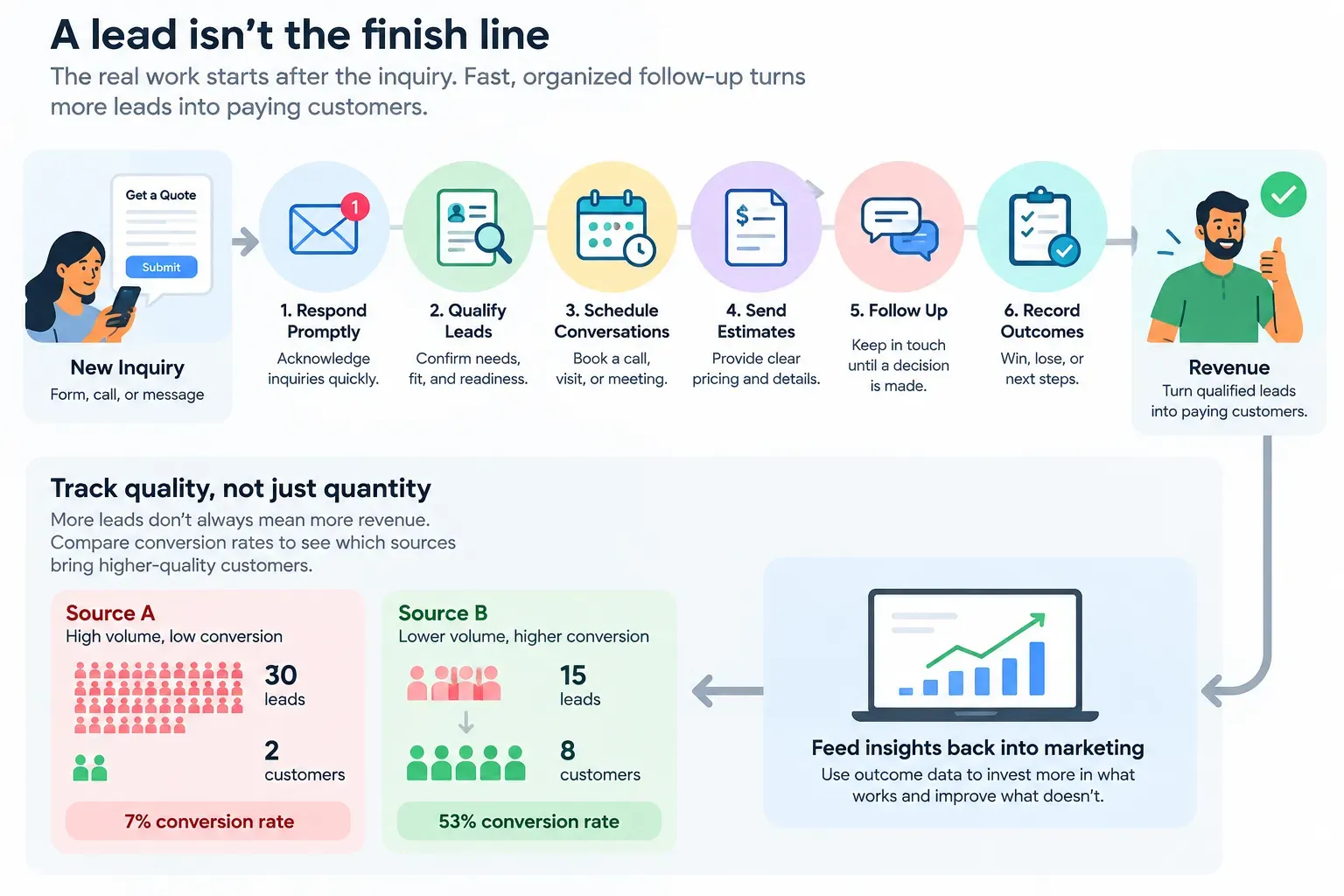
Getting the lead isn’t the finish line. The next stage is turning that inquiry into revenue. Fast, organized follow-up matters because potential customers may contact several businesses. Have a clear process for:
-
Responding to inquiries
-
Qualifying leads
-
Scheduling conversations
-
Sending estimates
-
Following up
-
Recording outcomes
Then feed that information back into marketing. If one source generates 30 leads but only two become customers, while another generates 15 leads and eight become customers, lead volume alone would give you the wrong picture. Track quality, not just quantity.
Don’t forget the customer after the sale
Existing customers can feed future growth too. After providing the service, your process might include:
-
Requesting a review
-
Asking for feedback
-
Sending useful follow-up information
-
Promoting relevant additional services
-
Staying connected through email
-
Encouraging referrals
A satisfied customer can become a repeat customer, reviewer, or referral source. That turns the funnel into something closer to a growth loop.
Build a Funnel Where Every Stage Adds Power
A strong funnel isn’t a single campaign, a single SEO tactic, or a single landing page. It’s the connection between them. Search visibility gets attention. Your Google Business Profile adds local context. Service pages explain your value. Reviews build confidence. Calls to action generate leads. Follow-up turns those leads into customers. When those pieces aren’t connected, potential customers can fall through the gaps.
At Hite Digital, we know how frustrating it is to invest in SEO and digital marketing without seeing enough qualified opportunities come through. We bring SEO, websites, paid media, content, and strategy together to build connected systems focused on measurable business growth. If you’re ready to turn more local searches into leads instead of watching traffic disappear, explore Hite’s digital marketing services or connect with our team.